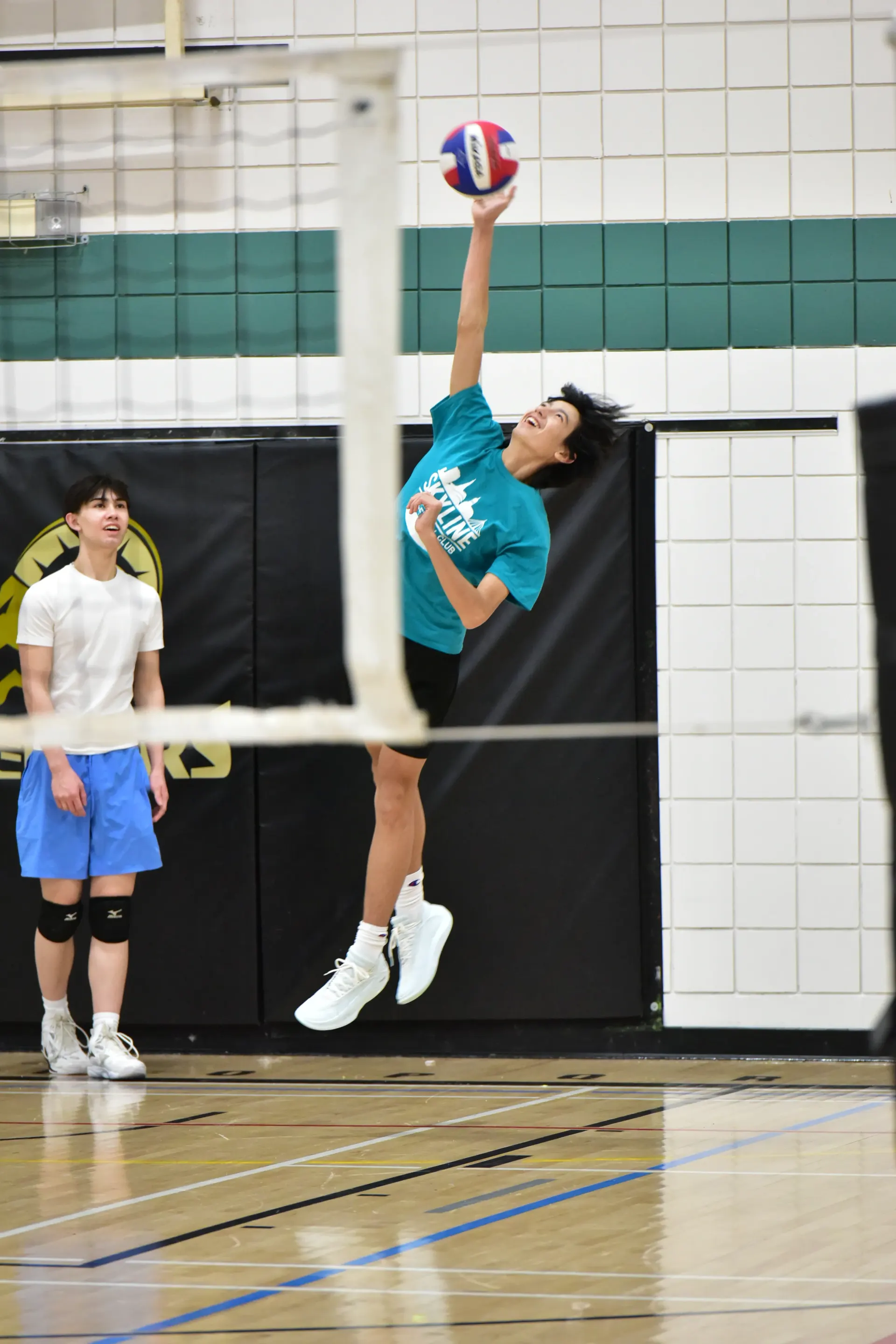
- Drop a towel in one back corner
- Serve from behind the end line
- Run your match-day routine every time
Athlete Resources · Calgary, Alberta
Volleyball Training Tips for Calgary Athletes
Nine practical guides from Skyline’s NCCP-certified coaches covering solo drills, technique cues, a stronger jump, every position, tryout prep, mindset, fuel and travel, injury care and the path to university volleyball.
- Players aged 12–18
- Tryouts: girls U13–U17, boys U16
- Indoor club volleyball
- NCCP-certified coaches
Pick a Topic
Volleyball Training Topics for Calgary Players
Each guide opens with the essentials and keeps the deeper material folded underneath. Jump straight to what you need today.
01Solo Training
Solo Volleyball Training Between Practices
No gym booked? A basement, a garage or a backyard on a mild Chinook afternoon gives you enough room for extra touches between team practices.
The ball-control ladder
Climb one rung at a time. You move up only after finishing a rung without the ball hitting the floor.
| Rung | Challenge |
|---|---|
| 1 | Forearm juggling: 20 bumps to yourself while standing still |
| 2 | Overhead juggling: 20 sets to yourself, each one rising at least a metre |
| 3 | Mix it up: bump, then set, then bump again, for 30 touches |
| 4 | Lying sets: on your back, fingertips only, 40 pushes straight up |
| 5 | Moving touches: travel the length of the room bumping and setting, never stopping |
Serve targets on an outdoor court
From May to September, plenty of Calgary parks and schoolyards have sand or grass space. Bring a bag of balls and an old towel.
- In the court earns one point
- Hitting the towel earns three
- Play to 30 and write your total down
Pick a fence or rope at roughly net height and serve over it from about nine metres back, the depth of one side of a court.
A 25-minute garage circuit
Use it on two or three days a week that are not back to back. Wear proper shoes, and call it a day if a joint complains.
| Station | Work |
|---|---|
| Prep · 6 min | Skipping (with or without a rope), lateral lunges, inchworms, a long lunge with a reach |
| Legs · 3 rounds | Backpack goblet squats ×10 · Step-ups onto a sturdy bench ×8 each side · Single-leg calf raises ×15 |
| Core and shoulders · 3 rounds | Dead bugs ×10 · Bird dogs ×8 per side · Wall angels ×10 · Face-down Y, T and W raises ×6 each |
| Quick feet · 2 rounds | Line hops forward and back, then side to side: 20 seconds on, 40 seconds off |
| Finish · 4 min | Easy walking, then the post-practice stretches in the Injury Care guide |
02Technique
Volleyball Technique: Coaching Cues and Quick Fixes
Coaches use short cue words so a skill can be corrected in the middle of a drill. Learn the cue, notice your own fault, then run the fix.
Cue sheet for five skills
Read each row from left to right: the cue to remember, the fault coaches spot most often, and a drill that cures it.
| Skill | Cue | Typical fault | Fix drill |
|---|---|---|---|
| Float serve | “Toss, step, pop” | The toss drifts behind your head | Ten tosses that land on your front toe, no swing |
| Forearm pass | “Feet, then freeze” | Arms swing up at the ball | Partner tosses; hold your finish for two seconds |
| Set | “Forehead window” | The ball drops to chest height | Overhead juggling while walking forward |
| Attack | “Slow, fast, faster” | Jumping forward into the net | Approach to a tape line and land behind it |
| Block | “Seal the tape” | Arms swing down through the ball | Jump beside a wall, palms flat and high, then hold |
A serve routine that holds up under pressure
Nerves shrink when every serve begins the exact same way.
- Pick a zoneChoose your target before the whistle goes.
- ResetBounce the ball the same number of times, every serve.
- Breathe outOne long exhale lets go of the last rally.
- CommitToss and swing with no second thoughts.
Reading the ball on serve receive and defence
Good passers start moving before the ball crosses the net. Watch for these clues.
Square shoulders usually send a deep ball straight ahead. A turned body often means a short or angled serve.
A dropped elbow tends to mean a tip or roll shot. Stay low and take two steps forward.
Shout “mine” early and loud. Late calls cause more shanked passes than poor technique does.
Attack options besides hitting hard
Smart hitters carry three or four shots, not just one.
- Line: swing down the sideline when the block leaves it open.
- Cross-court: turn your shoulder and drive toward the far corner.
- Roll shot: slow topspin over the block into the middle of the floor.
- Tool the block: aim at the outside hand so the ball deflects out.
03Vertical Jump
Vertical Jump Training for Youth Volleyball Players
Jumping is a skill as much as a strength. Tidy up how you take off and land first, then build power over weeks instead of days.
Measure before you start
A baseline lets you see real progress instead of guessing.
Stand side-on to a wall, stretch one hand up and mark the highest point you touch.
From a standstill, jump and tap the wall. The gap between the marks is your vertical.
Take your full approach and tap again. Retest every three weeks.
A six-week jump plan
Two sessions a week with a rest day between them. Keep every rep crisp, and end the set once the height starts to drop.
| Weeks | Focus | Sample session |
|---|---|---|
| 1–2 | Landing and posture | Step-off and stick landings 3×5 · Squat holds 3×20 s · Low hops in place 2×15 |
| 3–4 | Strength | Split squats 3×8 each leg · Hip thrusts 3×10 · Single-leg calf raises 3×12 |
| 5–6 | Power | Jumps onto a low box 3×5 · Broad jumps 3×4 · Approach jumps to a target 3×4 |
Growth spurts and jump load
While you are growing, tendons and knees can stay sensitive for months.
- Soreness just under the kneecap, or on the bump at the top of the shin (Osgood-Schlatter), is common in jumpers aged 10 to 15.
- Count every jump: practices, matches and home training all add to the total.
- Still sore the next morning? Take jumping out for a few days and tell your coach and a physiotherapist.
- Lift weights only with a coach watching, and start light.
04Positions
Volleyball Positions Explained Through a Single Rally
Follow one point from serve to kill and you see what every player on the floor is responsible for.
One rally, six jobs
The other team is serving. This is who does what.
| Moment | Who acts | What they do |
|---|---|---|
| Serve arrives | Libero and outside hitters | Form the receiving line and pass to the target zone |
| Second contact | Setter | Runs in from right back, reads the pass and picks a hitter |
| Attack | Middle, outside or opposite | The middle runs a quick to freeze the blockers while the outside swings on a high ball |
| They dig and swing back | Opposite and middle | Close a two-person block on the hitter on their left side |
| Ball back on our side | Libero and defensive specialist | Dig it up so the setter can launch the next attack |
Finding the right fit
Young players should rotate through every spot. Around U15 or U16, most athletes begin to specialise.
Setters touch the ball on almost every rally and talk constantly. Calm decision-makers thrive here.
Middles live at the net, blocking side to side and hitting fast tempo sets.
Liberos and defensive specialists pass serve and dig. Height does not matter; reading the hitter does.
Rotation basics
There are six spots, numbered 1 to 6 counter-clockwise starting with the server. Your team rotates clockwise each time it wins back the serve.
- At the moment of the serve, players must stand in the right order beside and in front of or behind their neighbours. Being out of place is an overlap fault.
- Once the ball is served, everyone can move to their playing spot.
- A back-row player may not jump from in front of the 3-metre line and hit a ball that is completely above the net.
- Common systems: 5-1 (one setter), 6-2 (two setters, each setting from the back row) and 4-2 (two setters setting from the front row, handy for younger teams).
05Tryouts
Getting Ready for Club Volleyball Tryouts in Calgary
Skyline 2027 tryouts run over three sessions: November 29 (Sunday), December 5 (Saturday) and December 6 (Sunday). The divisions: girls U13/U14, U15 and U16/U17, and boys U16. One $50 registration covers all three sessions in your division.
Checklist before the first session
Most tryout-day problems start before anyone touches a ball.
- Buy the Volleyball Alberta 2027 Youth Development Player – Tryout membership. Without it you cannot step on the court.
- Register for your division on the Skyline tryouts page ($50 for all three sessions).
- Note your session times: every division has its own slot on each of the three days.
- Pack court shoes, knee pads, a full water bottle, a snack and a hair tie.
- Playing senior varsity at your high school? Under Alberta’s school rule, senior varsity high school players may not take part in non-school volleyball from August 31 to November 28, so the November 29 session is the first one you can join.
Session by session
Each session builds on the one before, so plan to attend all three.
| Session | Gym | Our tip |
|---|---|---|
| Sunday, November 29 | Western Canada High School | First impressions: hustle between drills, talk, learn names |
| Saturday, December 5 | MNP Community & Sport Centre | Show what you fixed since day one; coaches notice change |
| Sunday, December 6 | Western Canada High School | Game play: your calls, serve receive and how you react to errors |
What goes on the score sheet
Six areas, scored the same way for every athlete.
Speed, balance and the power behind your jump.
Clean contacts when you serve, pass, set, attack and block.
How efficiently you reach the ball and get set before contact.
Seeing the play early and picking the right option.
Chasing every ball and staying loud when the score is against you.
Listening, then trying the correction on the very next rep.
06Mindset
Building a Strong Volleyball Mindset
Skills put you on the court; your head keeps you there. Mental habits are trained like a serve, a little every day.
Self-talk that actually helps
Swap the voice that criticises for one that coaches.
| Instead of… | Try… |
|---|---|
| “Don’t miss this serve.” | “Smooth toss, zone 5.” |
| “I always shank that.” | “Feet to the ball, quiet arms.” |
| “We’re going to lose.” | “Win this rally.” |
| “Coach is mad at me.” | “What’s the fix? Do it next ball.” |
Goals you control
Results depend partly on the other team. Process goals depend only on you.
Set a single skill goal for the month, such as 85% of serves in at practice.
Jot a quick note after each practice. Numbers reveal progress that feelings miss.
Five minutes each weekend: what went well, and what to try next week.
School, club and staying well
Club season overlaps with exams, jobs and high school sports.
- Map out the week every Sunday: practices, homework and downtime.
- Let your coach know about exam weeks early. Asking is normal.
- Keep one day a week completely free of volleyball.
- Feeling down, anxious or burnt out for more than a couple of weeks? Talk to someone you trust. Kids Help Phone answers day and night at 1-800-668-6868, or text 686868.
07Fuel & Travel
Fuel, Rest and Travel for Club Volleyball Athletes
Calgary air is dry, and a club weekend can mean a drive to Edmonton or Red Deer. Plan water, snacks and sleep the same way you plan practice.
Building a training plate
Picture each meal in three parts.
Fruit and vegetables, fresh or frozen.
Rice, pasta, bread, potatoes or oats.
Chicken, fish, beans, eggs, tofu or Greek yogurt.
Tournament weekends and road trips
Weekend events can run from early morning into the evening.
| When | Plan |
|---|---|
| Friday night | A familiar dinner with plenty of carbs; lay out your uniform, pads and snacks |
| On the highway | Pack a cooler with sandwiches, fruit, yogurt tubes and crackers; stretch at every stop |
| Between matches | Small bites every hour or two; skip greasy food-court meals right before you play |
| Water | Sip all day. Dry prairie air and hotel rooms dehydrate you faster than you notice |
The Dominican Republic tour
Teams U15 and older can join the tour in late February to early March 2027, two teams a week, organised by V Sports International.
- Heat and humidity are a big jump from a Calgary winter: drink more than feels necessary, and wear a hat and sunscreen between matches.
- Drink bottled or treated water and read the Government of Canada travel advice before you leave.
- These Volleyball Alberta Premier weekends fall in the same window, so compare them with your travel week:
| Premier | Dates (2027) |
|---|---|
| 16U Girls Premier 1 | Feb 20–21 |
| 15U Girls Premier 2 | Feb 27–28 |
| 14U Girls Premier 2 | Mar 6–7 |
| 16U Girls Premier 2 | Mar 13–14 |
Sleep and recovery
Your body adapts while it rests, not while it works.
Most teenagers need between eight and ten hours a night. Put the phone away half an hour before lights out.
Walk and stretch for five minutes before you leave the gym.
Plan at least one full day a week with no training at all.
08Injury Care
Preventing Common Volleyball Injuries
Ankles, knees and shoulders take the most wear in volleyball. A dynamic warm-up, a strong body and honest reporting keep you playing.
A dynamic warm-up in four parts
Save the long static stretches for after practice.
- Pulse upJog the court lines, then skip and shuffle for two minutes.
- Open upWalking lunges with a twist, high knees, and arm circles both ways.
- Switch onMini-band side steps, glute bridges and scapular push-ups.
- Fire upTwo-foot hops, short sprints and three easy approach jumps.
Ankles and shoulders
The two injuries club players report most often.
The classic one comes from landing on a teammate’s or an opponent’s foot at the net. Practise landing in your own space and add single-leg balance work.
Many club players wear lace-up braces, especially after an earlier sprain. Ask a physiotherapist which kind suits you.
Hundreds of swings add up. Band rows and external rotations twice a week protect the back of the shoulder.
Coming back after an injury
Going back too soon is the main reason players get hurt a second time.
- Have it checked by a physiotherapist or doctor.
- Return in stages: walking, jogging, jumping, then full practice.
- Tell your coach exactly what you can and cannot do yet.
- Any blow to the head means you stop for the day and follow the concussion return-to-sport steps.
Stretches after practice
Hold each one for 20 to 30 seconds and breathe slowly.
| Area | Stretch |
|---|---|
| Hips and thighs | Half-kneeling hip flexor stretch, standing quad pull |
| Back of the legs | Seated hamstring reach, calf stretch against the wall |
| Shoulders and back | Arm across the chest, doorway chest stretch, child’s pose |
09Recruiting
University and College Volleyball Recruiting for Alberta Players
Coaches find players at club tournaments, showcases and through highlight videos, and plenty of strong programs are close to home.
Alberta programs to know
These schools compete in Canadian university and college volleyball.
| League | Alberta schools |
|---|---|
| U SPORTS (Canada West) | University of Calgary Dinos, Mount Royal University Cougars, University of Alberta Pandas and Golden Bears, MacEwan University Griffins, University of Lethbridge Pronghorns |
| CCAA (ACAC) | SAIT Trojans, Ambrose University Lions, Red Deer Polytechnic Queens and Kings, NAIT Ooks, The King’s University Eagles, Lakeland College Rustlers, Augustana (U of A) Vikings |
| NCAA | US schools in Divisions I, II and III. Register with the NCAA Eligibility Center; Division III offers no athletic scholarships. |
Emailing a coach
Short, specific and personal gets answered.
- Subject lineName, grad year, position, height and club.
- First linesWhy their program, plus your grade average.
- LinksYour highlight video and club tournament schedule.
- Follow upA brief update after each big tournament.
Year-by-year checklist
Small steps each year beat a rush in Grade 12.
| Grade | This year |
|---|---|
| 9 | Play club, try two positions, keep marks you are proud of |
| 10 | Start filming matches; ask your coach which level suits you |
| 11 | Build a highlight video, email coaches, attend ID camps |
| 12 | Visit campuses, apply early, compare athletic awards and programs |
Short Answers
Common Questions From Young Volleyball Players
What can I practise at home without a court?
Juggling with your forearms and fingertips, lying sets, footwork and a short strength circuit all fit in a basement or garage. Ten to fifteen minutes most days adds up fast.
How soon will my vertical jump improve?
Most players notice a difference within six weeks if they fix their landing and approach first, then add strength and power work twice a week.
What is the easiest serve to learn first?
The float serve. A steady toss in front of your hitting arm, a step and a firm, flat contact that stops on the ball make it reliable.
Which volleyball position suits me?
Play them all while you are young. Later, quick hands point to setter, long arms and timing to middle, and calm passing to libero or defensive specialist. Your coach can help you choose.
Is a Volleyball Alberta membership required for tryouts?
Yes. Every athlete must buy the Volleyball Alberta “2027 Youth Development Player – Tryout” membership before the first session. Athletes without it cannot take part.
When and where are Skyline tryouts in Calgary?
For 2027: November 29 (Sunday), December 5 (Saturday) and December 6 (Sunday), at Western Canada High School and MNP Community & Sport Centre. One $50 registration covers all three sessions in your division.
Can high school senior varsity players attend club tryouts?
Yes, from November 29. Under Alberta’s school rule, senior varsity high school players may not take part in non-school volleyball from August 31 to November 28.
What happens if I am not selected?
Keep training at camps, and try out again next season.
What should I eat on a tournament day?
A familiar breakfast, then small snacks every hour or two between matches: fruit, sandwiches, crackers, yogurt. Sip water all day.
Should I wear ankle braces for volleyball?
Many club players do, especially after a sprain. A physiotherapist can tell you whether a brace, balance training or both makes sense for you.
Which Alberta universities have volleyball teams?
In U SPORTS: Calgary, Mount Royal, Alberta, MacEwan and Lethbridge. Many colleges and polytechnics, such as SAIT, Ambrose, Red Deer Polytechnic and NAIT, play in the ACAC.
Train With Skyline
Volleyball Camps With Skyline
Guides get you started; coached reps make it stick. Pick the program that matches where you are this season.
For club athletes aiming higher.
Advanced technique, position detail and decision-making at a high-rep, high-tempo pace.
See High Performance CampsOne skill or one role at a time.
Serving, attacking, passing or defence, or focused work for setters, middles, outside hitters and liberos.
Browse CampsA week of training in summer.
Daily skill sessions and team play, ending in a Friday championship tournament.
Summer CampsFees a worry? The Athlete Access Fund offers up to $500 a year toward registration, with applications reviewed monthly.
Programs
Volleyball Camps and Programs in Calgary
From drop-in open gyms to summer day camps and position training, there is a Skyline program for every young player.